Keeping pipelines safe from internal corrosion can be a challenging and expensive business; industry estimates run to several billion dollars annually in the U.S. alone. Pipeline accidents have caused catastrophic injury and destruction, resulting in the U.S. Department of Transportation (USDOT) imposing integrity management requirements on pipeline operators.
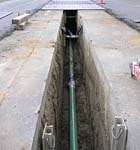
Panhandle Energy, a subsidiary of Southern Union, operates approximately 18,000 miles of interstate pipelines. "In 2006, Panhandle will perform over 300 anomaly investigations," says David McQuilling, a Senior Engineer for Panhandle Energy. "On average, we budget $50,000 per investigation in rural areas, but if you're in an urban area, $50,000 may not even cover permitting; I've heard of operators spending over $250,000 on a single dig."
Causes and Effects
Internal corrosion can occur when impurities are present within the natural gas, crude, and refined products being transported. Bill Shaw is an Engineering Professor at the University of Calgary and the director of the Pipeline Engineering Centre, which studies corrosion and monitoring. "Moisture is the big thing; if you had no moisture, for the most part, you'd be fine," he says. "It mainly mixes with salts, like chlorine, and sulphur compounds."Corrosion can typically reduce a pipeline wall thickness at a rate of 2-3 mils/year, but it can happen much more quickly in the upstream area of operations. "Gathering systems are really bad. You have large quantities of hydrogen sulphide and brine," says Shaw. Water can chemically react to form very corrosive liquids that collect in low-lying spots. Corrosion rates in these areas may reach several hundred mils per year.
To mitigate the potential for incidents related to internal corrosion, the pipeline industry works assiduously to reduce risk. The USDOT's Pipeline & Hazardous Materials Safety Administration (PHMSA) notes that 258 natural gas and liquid pipeline accidents (14% of which were caused by internal corrosion) occurred in 2004. "It is important to place natural gas pipeline safety data in perspective," says Don Santa, president of the Interstate Natural Gas Association of America. "INGAA's members operate a network of approximately 200,000 miles of transmission pipeline, and this total does not include all of the intrastate transmission pipelines and LDC-owned pipelines that also are subject to the Department of Transportation's integrity management rules. Pipelines are one of the safest modes of transportation."
But when they do fail, they tend to get noticed. Early in the morning of Saturday, August 19, 2000, a natural gas line exploded in south-eastern New Mexico near the Pecos River. Eleven nearby campers were killed by the blast and fire. The ensuing fireball was large enough to be seen in Carlsbad, NM, 20 miles to the north. Federal investigators determined that the cause was severe internal corrosion; over 70% of the wall had been eaten away near the rupture.
Partly in response to the tragedy, the Bush Administration enacted the Pipeline Safety Improvement Act (PSIA) in 2002. "Under the PSIA, pipelines have to inspect all High Consequence Areas within a 10-year span, and then, after the initial inspections are done, they have to go back and inspect at 7-year intervals," says Don Santa. The Office of Pipeline estimates that natural gas pipeline companies alone will spend $4.7 billion over 20 years complying with the legislation (and for those that don't, civil penalties of $25,000 to $100,000, and fines up to $1 million for repeat violations, could be levied).
In order to comply, pipeline operators rely on a range of survey methods supplied by third parties. Prominent companies supplying internal corrosion monitoring equipment include Rohrback Cosasco of the U.S., Corrocean in Norway, Cormon in the UK, and Caproco in Canada. The international market for corrosion-monitoring equipment is in the neighbourhood of $70 million annually, and is growing rapidly due to the fast pace of oil and gas developments, expansion of pipeline networks around the world, and the increasing stringency of regulation.
Internal Monitoring and Detection
Generally, internal corrosion monitoring & detection is broken down into three techniques: intrusive, In-Line Inspection (ILI), and non-intrusive. "Intrusive methods include electrical resistance probes and coupons," says Shaw. The coupon is the original form of intrusive corrosion monitoring. It consists of a strip of metal about 3 inches long and 1/8 inch thick, made of material similar to the pipeline. It is weighed, then inserted it into an access point and left for at least six months. The operator then removes the coupon and weighs it again to see what percentage is missing.
The coupon is inexpensive and reliable, but several factors can outweigh the advantages. First and foremost is access above the area of concern. "Corrosion often occurs at low spots, under roads or rivers," says McQuilling. "It's often impossible to put a coupon in the location where the internal corrosion is occurring. If access to the area is possible, burial depths must be considered, as coupons are commonly installed and retrieved at line pressure. It is impractical to install coupons at pipe depths greater than 10 to 15 feet below grade. I've had situations where pipe was removed and replaced due to internal corrosion, but a coupon was not considered due to safety concerns about insertion and extraction of a 27-foot-long coupon/coupon staff assembly at 1,950 psig."

Ultrasonic Monitoring
The most common non-intrusive device is the ultrasonic monitor. To conduct a survey, the pipeline is dug up, then a portable device is held against the metal. Inside the device, voltage is applied across a piezoelectric crystal to generate an ultrasonic sound wave that propagates through the metal. The time it takes to travel through the metal and back to the transducer is directly proportional to its thickness.The devices are quick, easy to use and inexpensive, and operators do not have to shut off flow or risk breeching the pipeline in order to take a reading. On the other hand, they still have to expend thousands of dollars digging up the pipeline each time they run a test. Also, traditional ultrasonic monitors have a sensitivity range in the order of 5-10 mils accuracy, so if the corrosion is only 3 mils/y, it takes three years to start to see it in a statistically significant manner.
Rohrback Cosasco Systems, based in California, is a pioneer in the measurement of corrosion by way of electrical resistance and ultrasound. The company has more than 80 employees and 50 representative companies around the world (75% of their business is in the international oil and gas sector), with annual sales of over $20 million. "We saw the potential for a high-speed, high sensitivity device that could be permanently installed, and began to focus on development in 2003," says Brent Ford, the CEO of Rohrback Cosasco.
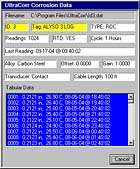
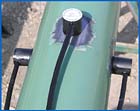
The company devised the UltraCorr® wall thickness monitor, a combination of permanently mounted transducers and a portable data logger. "Problem areas, which are typically located at low spots, are identified by pigging or some other means, then dug up,"