
Patent law is constantly changing, with new theories and defenses developed by various federal, district and state courts, as well as the legislature. Patent law is a federal law and related intellectual property includes trademarks (which are matters of federal and state law), copyrights (which are matters of federal law) and trade secrets that are governed by state laws.
Rights and Ownership
A patent is a right granted by the United States government that gives the owner of the right the ability to exclude others from making, using, selling and offering for sale the invention defined in that monopoly. A patent is a property right granted in the U.S. Constitution. Specifically, Article 1, Section 8 (the patent and copyright clause) reads:
The Congress shall have power … To promote the Progress of Science and useful Arts, by securing for limited Times to Authors and inventors the exclusive Right to their respective Writings and Discoveries.
Owning a patent does not entitle the owner to do the activity or make the product described in the patent. Rather, a patent is a right granted an owner to stop others from using the owner’s property. Congress intended that by granting these monopolies, innovation would be encouraged. However, a grant of a patent does not guarantee the owner of the patent that the invention does not infringe someone else’s patent right.
Several kinds of discoveries are patentable. These include:
• Methods - a sequence of steps to do something
• Devices - equipment, a tool, a widget
• Software
• Processes - manufacturing steps to make something
• Business Methods - a way of doing business
• Designs of useful articles, like air conditioning vents
• Systems - assemblages of equipment that work together
• Compositions of matter, chemical formulations - adhesives, paints
• Improvements to non-patentable inventions.
Patents are a hybrid of real property and personal property and can be assigned and transferable. Patent applications and issued patents can be bought, sold, assigned, traded, transferred, licensed, bequeathed, escrowed, placed into trusts and otherwise moved about like personal property.
Patents, and patent applications, can be owned by one person, a company, two or more individuals, two or more businesses, individuals and a business, or other entities that are created by law. Patent rights are codified in 35 U.S. Codes, and rules related to patents can be found in 37 Code of Federal Regulations. However, it is easy to read more about patents by looking at the government’s Web site (www.USPTO.gov).
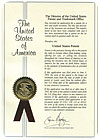
An official ‘granting of patent’ notice.
Obtaining Patent Rights and Issued Patents
The right to an invention occurs by the inventor undertaking some specific steps. An inventor must 1) describe the invention in a patent application, 2) file the patent application with the federal government and 3) pay the filing fee.If a business organization or a person that is not the inventor desires to own an invention, a written assignment from the inventor to the new owner must occur. Written assignments transferring ownership should be recorded at the U.S. Patent Office.
In the U.S., all inventions are owned by their respective inventors unless the inventor has transferred the invention to a company with a written employment agreement or similar agreement (like a secrecy agreement with assignment language) or by signing the assignment document used by the U.S. Patent and Trademark Office.
To obtain an issued patent, the inventor or a company owning the technology must do several things:
1) Make a filing at the U.S. Patent and Trademark Office (USPTO) either online at www.USPTO.gov or by mail to the USPTO offices in Alexandria, VA, and provide:
a) the names of each inventor of the discovery,
b) a description of the discovery, with at least one example in enough detail to enable “someone skilled in the art to which the invention pertains” to understand;
c) the filing fee to the government, which in 2008 could be a small entity fee of less than $500 to a large entity fee of more than $1,500. A “large entity” is an organization having more than 500 employees; and
d) an oath or declaration about inventorship, and drawings if needed to describe the discovery;
2) Respond to a paper from the U.S. Patent and Trademark Office called “An Office Action” after the government has examined the discovery to determine if someone had already invented it or described it in a printed publication or used it commercially more than one year before the filing date;
3) Receive a Notice of Allowance from the government and respond to it with correcting Figures or modifying text if needed;
4) Receive the Issue Fee papers from the government;
5) Pay the patent issue fee to the government stated in the Issue Fee papers; and
6) Be happy when the printed patent arrives in the mail.
Generally, the response to the Office Action will cost anywhere from $3,000 to $6,000 in attorney fees after the initial filing. The response to the Office Action also brings a right to “Interview” the Examiner who examined the case in person in Washington, D.C., which is a highly effective way to resolve misunderstandings of the invention by the Examiner.
From filing until issuance, the patenting process takes from 2 to 8 years. The issued patent is valid for 20 years from the date of filing if maintenance fees are paid to the U.S. Government at least three times during the time period after the patent issues.
Legal Requirements for a Patentable Invention
There are three primary legal requirements for a discovery to be patentable and an invention must meet all three criteria. The discovery must be: 1) “Useful,” 2) “New” or “Novel” and 3) “Non-Obvious,” as these terms are defined by Section 35 of the U.S. Code.
To be useful an invention must meet the requirements of 35 USC Section 101 - the invention must “do” something. The invention can be a method for doing business to be useful. It can be a part that is a replacement of another part in a system. It can be a coating that seals a pipe or it can be a new sprayer for a sprinkler system.
To be novel an invention must meet the requirements of 35 USC Section 102 - the invention was not in public use, disclosed to members of the public, offered for sale, used commercially (though possibly in secret) or written up in a printed publication more than one year prior to the U.S. filing date of the invention.
Examples of activities that have prevented filing a patent on the exact invention disclosed include:
a) describing the invention in an abstract submitted to a professional association more than one year before the filing date;
b) inviting the press to view a demonstration of a new fire protection unit and then trying to file on the fire protection unit more than one year later;
c) creating a prototype of a new hydronics device, showing the prototype at a trade show, and then trying to patent the prototype more than one year later;
d) making a proposal to a client describing the new system for plumbing modular buildings at a wind farm, and then trying to file a patent on the invention more than one year later; or
e) sending out a two-paragraph press release prior to attending a trade show, and then more than one year later trying to file a patent application on the invention.
To be non-obvious an invention must meet the requirements of 35 USC Section 103 - the invention must not be what someone skilled in the art would have expected.
Non-obviousness is really a standard for the patent attorney to determine. Most engineers and regular people are not qualified to make a determination on what is considered “non-obvious,” even if they are very bright people. The recent Supreme Court decision in 2007, known as the KSR decision, added a new twist - “the inventive step” - as something that inventors need to write into their patent applications.
So it is a good idea for all inventors to write 1) a list of the problems that the new discovery addresses and solves, and 2) a list of terrific benefits, which, if possible, save the environment, save energy or save lives somehow.
If an invention is not patentable because it does not meet the definitions of new, useful and non-obvious, the invention may be kept and maintained as a trade secret and still be of value to the owner.
Examples of “patentable discoveries” (inventions) include:
• a method for plumbing a modular building in less time than currently needed;
• a gadget for doing a task, like a new type of pipefitting wrench;
• a system for doing a task, like a fire protection system with a new type of video, and audio monitoring and report generation that is pushed out to individual clients;
• a business method that does something new, such as a method to introduce sales of hydronic equipment to a sales force in a new and different manner;
• a process for manufacturing a component of a commercial building, such as equipment used to assemble sprinklerheads in the field prior to installation in a commercial building;
• a method for using an existing device in a new way, for a new benefit, such as a method for measuring sales of a plumbing organization by using a new type of parametric;
• a composition, like a new pipe coating composition that reduces static electricity shocks; or
• a computer program, such as computer instructions to determine the time it will take for a certain type of pipe to become brittle.
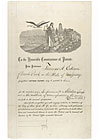
Shown is a letter from 1879 by Thomas A. Edison
requesting a patent for his improvement in electric lamps and method of
manufacturing the same. Courtesy: www.archives.gov.
Patenting, Copyrighting and Trademarking Discoveries
A federal copyright applies to works of authorship that are “expressions.” Expressions include books, computer programs, manuals, advertisements, drawings and any expression fixed in a media. For instance, software that designs plumbing products and/or tests pipe or examines x-ray analysis is a discovery that is not only patentable, but also copyrightable.However, it is important to patent first and copyright second because, by filing for a copyright, the patent holder immediately and instantly destroys all foreign rights that the inventor would otherwise be entitled to and have as an asset. The copyright owner has the exclusive right to copy, publish, perform, broadcast, sell, license, import and prepare derivative works of the expression.
A copyrightable work is protected by registering the work with the Library of Congress in Washington, D.C., or online at www.LOC.gov. The work generally registers in about nine months - and the protection afforded by the registration lasts for 70 years plus the life of the author, or 95 years if the author is a corporation. The TX form is for expressions that are text based, and the VA form is for expressions that are visual works of art.
The right to a work of authorship occurs when the author creates it, and the author, by employment agreement or assignment agreement, may transfer the author’s rights to the copyrightable to another party. An author is not required to register the work with the Library of Congress, but three rights are obtained by paying a $45 fee and filing the application and making a deposit of the copyrightable work: 1) a jail sentence of 1 to 5 years, 2) damages between $25,000 and $250,000 without having to prove damages, and 3) attorney fees to enforce the rights of the copyright owner.
A discovery can be “branded’ with a trademark. The trademark can then be registered and protected. The trademark does not protect the discovery; it protects the branded mark used on the discovery.
A trademark can be a name, a logo (such as the “swish” for Nike associated with shoes), slogan (such as “Leak Tite Pipe”), color (such as the color blue for Continental Airlines), sound (such as the “Intel™ Inside” sound sequence), shape (such as the Coca-Cola™ bottle shape) or smell that identifies a good or a service. The largest number of trademark filings are for a word mark, the simple word used with a product or a service.

The logo
of the U.S. Patent and Trademark Office, part of the Dept. of Commerce.
Trademark Application Filing and Benefits
Trademarks can be filed federally or with individual states. For example, there can be a state trademark in Texas for AutoSolutions™ and a federal trademark for the same name “AutoSolutions” for software related to remote terminal units. Trademarks, if filed federally, are a right, like patents, to exclude others from using the same name, or a name likely to be confused with that name for the same or similar good or service.A federal trademark, if registered, is a monopoly granted from the U.S. Patent and Trademark Office for 10 years, and is renewable upon payment of a fee to the federal government and proof of use during the prior three- to five-year period. Federal trademarks are renewable without limitation, provided use is shown and payment is made.
Only the owner of the trademark may file an application for its registration. An application filed by a person who is not the owner of the mark will be deemed a fraudulent filing and any resulting registered mark would be unenforceable. Generally, the person who uses or controls the use of the mark, and controls the nature and quality of the goods to which it is affixed or the services for which it is used, is the owner of the mark.
A trademark can be protected with a federal filing that requires an application, a fee and a specimen. Only an applicant with “a bona-fide intention to use the trademark associated with a specific good or service” is entitled to file and receive the registered monopoly for a trademark. Presently, there are 45 classes of trademarks, so one filing does not cover all goods or services of a company.
To obtain a trademark, the owner of the trademark must file an application with the U.S. Patent and Trademark Office and provide a statement as to the scope of the service or good associated with the mark, and a copy or actual specimen showing the use of the trademark in association with the good or service. The specimen can be a label or an advertisement, but is never a business card unless there is additional writing on the business card and the mark is for a service.
The U.S. Patent and Trademark office requires a fee to file. The application is examined and typically rejected. Once the application is determined by the government to not be 1) descriptive or 2) likely to be confused with someone else’s mark through phonetic equivalence, misspelling or some other way, then the mark will typically publish and then be registered shortly thereafter. The process is similar for a state registration of a state trademark.
Most lawyers would state the following as benefits of trademark registration:
• Evidence of ownership of the trademark;
• Federal court jurisdiction;
• Leverage to prevent others from claiming “Trademark Infringement”;
• Improves asset value; and
• Owner can request that customs enforces trademark.
A name or mark should be researched before use as a trademark. Searches may be conducted free of charge by the general public on the USPTO Web site (www.USPTO.gov).