This 110-year-old, 9,500 square-foot building-reportedly
built in 1875 as the mayor’s home-was transformed into GreenSource Cincinnati.
(All photos courtesy Aquatherm/Monroe Mechanical)
William “Ez” Housh IIIwas working toward obtaining his U.S. Green Building Council LEED Accredited Professional certification a few years ago when he came to the realization the Midwestern green building movement was severely lacking in one area - a working, breathing demonstration of green building technology.
As president ofMonroe Mechanical, a 54-year-old, family-owned mechanical design and HVAC company, Housh has never been one to shy away from innovation. And the more he thought about it, he decided Monroe Mechanical was the right company - and Cincinnati was the right city - for what would evolve intoGreenSource Cincinnati, a working building that features cutting-edge green technologies.
Monroe has been at the forefront of applying the most energy-efficient mechanical systems since its inception in 1954. Monroe was installing radiant heating systems in the 1950s, solar systems in the ’70s, and in the ’80s and ’90s was a pioneer in the application of geothermal technology in residential and commercial buildings (more than 700 geothermal units installed since 1988).

GreenSource Masterminds: William “Ez” Housh III (left) and
his son, Will Housh IV.
While GreenSource was initially going to be a mixed-use building, as Monroe approached its business partners and shared its vision, the building evolved into an educational resource and meeting center. Cutting to the essence of the green building movement, the Houshes sought to reuse a building in downtown Cincinnati.
The firm identified a 110-year-old, 9,500- square-foot building in downtown as an ideal site. The building, reportedly built in 1875 as the mayor of Cincinnati’s home, had been vacant for two years.

The second-floor mechanical room
includes two Lochinvar Silent Knight Boilers.
Planning For The Future
The entire renovation was designed as an open-sourced job, “so that there’s not a single product installed, but many, so that if a better product comes along it can be integrated into the project,” Housh III explains.The design of the building evolved as different sustainability-oriented companies became interested.
“The building became more of a live trade show,” Housh III notes. “Some equipment manufacturers were great about donating equipment to get it into the building and on display. That really helped us to keep different types of systems in the building and keep things affordable. However, it also created many last-minute changes as we implemented new products.”
Displaying the different technologies while keeping the systems flexible and not exceeding the fixed budget was quite challenging, saysShawn Jacobsof SJ Engineering, whose firm, along withGerald Noe Jr., of Architects LLC, helped in the project’s architecture and design aspects.
Extensive work on the structure was necessary because it had been vacant for two years and the last major MEP improvements occurred during the 1960s.
“We could accomplish a large part of that by using green mechanical systems,” Housh IV says.
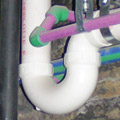
The basement mechanical room houses the
building’s Brac Graywater Reclamation system for recycled domestic
water collection.
Making sure the building was flexible enough to allow for the introduction of future projects was one of the most important considerations when planning the project, Jacobs says.
“As a result, we have a mixture of chilled water at various temperatures, heating water at various temperatures, split DX and variable refrigerant and energy recovery systems,” Jacobs says. “There was also a water-source heat pump in the design for a time. We have a wide variety of plumbing and building systems.
“It wasn’t a big project and it wasn’t time-consuming, but it was more challenging from the aspect of building it so you could add on later and not have problems.”
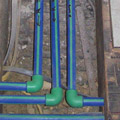
Climatherm piping runs from the
second-floor mechanical room to baseboard heaters located in the
front of the building on the second and third floors.
Piping Alternative
Aquatherm’s polypropylene-random (PP-R) piping systems were installed in the building. About 400 linear feet of Aquatherm Climatherm, designed specifically for HVAC applications, was used for the building’s four heating lines (two for supply and two for return). They run off twoLochinvarSilent Knight boilers located in the second-floor mechanical room and twoSlant/Finbaseboard heaters at the front of the building.The boilers were integrated with the PEX radiant floor system used under concrete flooring in the hospitality room. ADaikin ACair-to-air variable heat pump system was also employed on the project but was not integrated.
In keeping with the reuse theme, much of the original copper domestic hot water supply and return piping was retained since it was intact, but Monroe used Aquatherm Greenpipe (designed for potable water systems) for all the domestic cold water supply and return lines. The lines supplyKohlerfixtures, which were installed throughout the building.
A third PP-R piping option, Aquatherm Lilac, which is designed for reclaimed/recycled water applications, was used. Lilac (named and colored in order to differentiate it from potable water piping) was run from the basement mechanical room to the second- and third-floor toilets (two toilets to a branch) and to and from the graywater recycling system, which feeds the building’s five water closets and the sanitary drain. Lilac was also used for the drain line of the building’s backflow system. Finally, anAcornVacVacuum Plumbing and Drainage System and aBracgraywater reclamation system (for rainwater) were also deployed.

Monroe Mechanical employee Tim Pelphrey installs an 1875-era
Murdock drinking fountain on GreenSource Cincinnati’s third-floor green roof.
Jacobs emphasizes the use of the low-flow plumbing fixtures plays directly into the harmonization of different applications in the project.
“They definitely have their place,” he says. “If we didn’t have low-flow fixtures, it wouldn’t matter how much graywater we caught, we’d still be behind.”
Jacobs notes the building’s graywater system is believed to be the first one approved in the city of Cincinnati.
“With the overall design, the goal was to use as little city water as possible,” Jacobs says.
The green theme also ended up speeding up the project’s timeline.Mark Vincent, Monroe’s plumbing supervisor and a 30-year industry veteran, estimates each of the stacks running from the basement tank room to the third floor (one in the front and one in the rear of the building) took about an hour to install. Installing the same runs of copper would have taken at least two hours apiece, he notes.
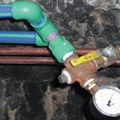
Located in the GreenSource Cincinnati
basement, this pressure gauge was placed on the piping system after
installation to check for leaks.
The entire mechanical system has been instrumental in the building owners applying for LEED Gold status.
“In the near future our energy savings will be displayed on monitors throughout the building down to the individual circuit level,” notes Housh IV.

The Houshes assist in the ribbon-cutting festivities at
GreenSource Cincinnati.
On The Cutting Edge
The building also boasts a biomass heater (Abundant Energy Works) that burns at 4,000 degrees F. The personal power plant acts like an industrial-sized pellet burner, burning anything that can be pelletized, including sawdust, trash and paper, and it is hooked into the heating and domestic hot water system and a 15kW generator. It burns so completely that it exhausts only water vapor.Monroe built a chute that runs from the garage to the burner in order to easily feed skids of pelletized biomass into the unit and expects to be able to power the building and even sell electricity back to the grid at times.
Additionally, a thermal solar storage system is in place - aRheemsolar thermal hot water heating system located on the third-floor roof that is connected to an insulated water storage tank in the basement.PEDCO, a Cincinnati engineering and architecture design firm, provided a chilled beam display and a simulated geothermal system.

This display in the foyer maps out the
building and lists all of the products installed.
The Only Game In Town
Asked about skeptics of all things green, Housh III says he doesn’t pay attention to such talk.“We’ve always made our projects energy-efficient and now that’s the only game in town,” Housh III says. “Energy savings and upgrades and making things more efficient is what it’s all about.”
While Monroe has invested more than $1.5 million in the project, Housh IV says the actual investment is a moving target.
“The partners have invested hundreds of thousands of dollars, but we don’t have financial partners, we have product partners,” Housh IV notes. “They saw it as an opportunity to get the product in front of people and we helped them achieve that.”
Entities such as the U.S. Green Building Council have held meetings at GreenSource, while a number of groups and individuals have toured it.
“The feedback we’ve been getting is that GreenSource Cincinnati is truly one of a kind in the U.S.” Housh IV adds. “Cincinnati has become the epicenter of green in the Midwest as the result of ours and other business leaders’ efforts.”