

Jay Peters
Concurrent with the release of the policy position statement, the Code Council moved its headquarters into a LEED (Leadership in Energy and Environmental Design) certified building in Washington, D.C., and soon thereafter created Sustainable Workplace Advocate Teams in each of its three regional offices. ICC’s activities were particularly visible at that time - and continue to be - but its commitment to sustainability is longstanding.

Fred Grable, P.E.
For years, the IPC has incorporated innovative technologies like waterless urinals and detailed engineered designs permitting the installation of smaller, more precise water and drainage systems - resulting in the savings of millions of gallons of water, not to mention countless miles of conduit materials.
ICC also works internationally with the World Plumbing Council (WPC), the World Toilet Organization (WTO) and, most recently, the Sustainable Sanitation Alliance (SSA). This de facto coalition of industries has brought its Plumbing, Mechanical and Fuel Gas (PMG) staff to Zurich and Tokyo and, later this year, to South Africa, Canada and Macau. It is also developing global guidelines in conjunction with the WTO for safe sanitation and clean water, an initiative that will reduce disease and help millions of people worldwide.
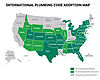
International Plumbing Code Adoption Map
The "Green Book"
Many professionals who use ICC’s Family ofInternational Codescasually refer to the IPC as the “green book.” Little did anyone realize that the color of the International Plumbing Code’s cover would also come to symbolize the environmental sustainability movement.It would be a flattering testament to ICC’s prescience if by the color selection of the IPC’s cover the Code Council had knowingly anticipated the global movement green would soon come to represent. Although no such credit can be taken, it can be said that the IPC’s contributors were thinking and acting in ways that guided its emergence as the code leader for sustainable plumbing installation.
Green building practices involve more than just selecting environmentally safe or recyclable materials. The designer must also see the bigger picture, often called the “cradle to grave” view. For example, he or she might choose cast iron drain, waste and vent piping because of the material’s recyclability. While this avoids the use of nonrenewable petroleum resources for the production of plastic pipe, it may not be the most sustainable option. The broader perspective would consider other issues, including:
Depending on the answers to these questions, plastic drainage piping might be a better choice because petroleum resources and plastic pipe manufacturing plants might be closer to the jobsite, its manufacture consumes a relatively low amount of energy, it weighs substantially less and, thus, requires less energy to transport, and it can be recycled using low-energy methods.
This example is not intended to promote plastic over cast iron piping, only to serve as an illustration of the important green implications a designer should consider. If cast iron pipe is manufactured relatively near the jobsite or plastic pipe is not readily available in the region, iron may well be the best choice.
Another factor that might influence the choice of cast iron over plastic would be the extra energy and special fill materials needed to properly install plastic piping underground in poor soil conditions. The point is that sustainability requires a careful consideration of all factors associated with the construction, use and eventual demolition of a building.
While the choice of materials used in plumbing systems today plays a part in green building practices, the most significant impact is achieved through efficiency: using less material. The IPC has always focused on methods to safeguard public health and safety using the least amount of materials possible. The following characteristics illustrate how the IPC supports sustainable plumbing installations.
There is a high probability that the 2009 edition of the IPC will incorporate additional sustainable methods; a single stack venting method and a siphonic roof drain method have been proposed and committee-approved, and are currently awaiting a final assembly vote. Whatever ICC’s membership decides, the IPC truly is and will remain a “green code,” not because of its cover but due to its progressive sustainable methods for plumbing installations and its long track record of allowing specially designed systems that assure a miminum level of safety, and, at the same time, a maximum level of efficiency
The National Green Building Standard
Even prior to the release of ICC’s green building policy position statement, the Code Council was involved in various green building-related projects. For example, the National Association of Home Builders (NAHB) and ICC were joint stakeholders in the creation of NAHB’sModel Green Home Building Guidelines, which were released in 2005. In addition, ICC’s award-winning magazine,Building Safety Journal, and its electronic periodicals regularly include articles and news items on various aspects of the subject, and its regularly updated Green Building Webpage,www.ICCsafe.org/green, provides a wealth of resources.Most recently, ICC partnered with NAHB in producing the (now-titled) ICC 700-2008National Green Building Standard(NGBS) - which is widely seen as ICC’s most ambitious green effort to date. The initial draft of the standard was based on NAHB’s aforementionedModel Green Home Building Guidelines, and the NGBS will be the first residential green building standard created under American National Standards Institute (ANSI) protocol, with the NAHB Research Center administering the process in their capacity as Secretariat. Draft Standard No. 2 of the NGBS has been approved by the NGBS Consensus Committee and has been submitted to ANSI for approval.
The NGBS is intended to rate the environmental impact of residential structures, including new construction, renovations and additions. It can be administered by any adopting entity, such as a governmental jurisdiction, green building program, or any other adopting third-party compliance-assurance body. The standard addresses environmental concerns through consideration of the following general criteria.
An Active Commitment
As with its partnership with NAHB in the production of the NGBS, ICC works with many organizations that are leaders in the green and sustainable building movement. A Code Council staff member serves as consultant to the Consensus Committee in the ANSI process, which is being utilized to create ASHRAE/USGBC/IESNA 189.1, Standard for High-Performance Green Buildings Except Low-Rise Residential Buildings.Also, ICC Evaluation Service is a voting member of the Consensus Committee in the ANSI process that is being used to create the Green Building Initiative’s Green Globes v.1 Post-Construction Assessment green building standard for commercial buildings. The Code Council also advocates for green building on Capitol Hill (as well as directly to state and local jurisdictions), has added many new green publications to the ICC bookstore, and attends and exhibits at green building conferences, expos and educational events.
For those in the know, none of this will come as a surprise. The IECC has been accepted by many jurisdictions as the flagship for energy saving installations and is now the most widely adopted energy code in the world, and the Code Council’s building and residential codes have always promoted building durability and safeguarded public health and welfare right along with public safety.
In fact, the International Codes could well be viewed as the foundation on which the majority of modern green and sustainable programs and standards are based. After all, without regularly maintained, fair and enforceable codes like those produced by ICC, there would be no firm framework on which to hang the fruit of a safe and healthy built environment for the generations to come.
Industry-leading organizations like ICC move at such a fast pace that, by the time they toot their horn, they have often already passed the next mile marker and no one hears them. Nonetheless, the Code Council will continue to move at light speed and hope that people will notice us as we zoom by. If they don’t, we'll be back around again on the next lap to pick them up!